Evaluating Busquets: A Distinctive Typeface for Bold Branding and Design
In the crowded landscape of digital typography, finding a font that balances modern aesthetics with genuine uniqueness can be a challenging task. Designers often oscillate between safe, ubiquitous sans-serifs and overly decorative scripts that compromise readability. Busquets emerges as a compelling middle ground, offering a striking and innovative typeface designed to stand out without sacrificing structural integrity. For professionals aged 20 to 50 who are tasked with creating memorable headlines, logos, or branding materials, understanding the specific utility and limitations of Busquets is essential before integrating it into a project workflow.
This evaluation explores what makes Busquets distinct, how it compares to other design approaches, and the practical considerations involved in its implementation. By examining its PUA encoding, stylistic nuances, and ideal use cases, we can determine when this font serves as a powerful asset and when a different typographic solution might be more appropriate.
The Distinctive Character of Busquets
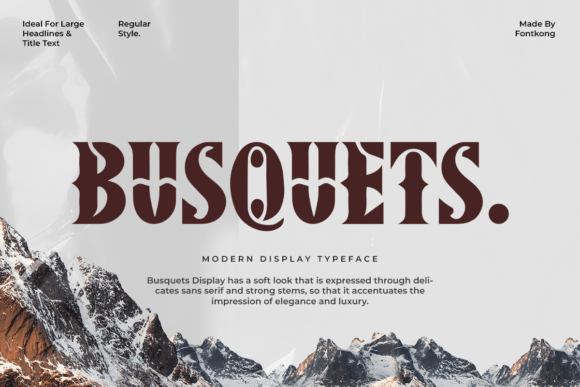
At its core, Busquets is defined by its unconventional style and eye-catching details. Unlike standard geometric or humanist sans-serifs that prioritize uniformity, Busquets introduces irregularities that create visual tension and interest. This distinctive design allows it to function effectively as a display typeface, where the primary goal is to capture attention immediately.
The font combines modern aesthetics with a touch of uniqueness that feels both contemporary and slightly retro. Its strokes vary in weight and texture, avoiding the sterile perfection often found in corporate identity systems. This "fresh and dynamic edge" makes it particularly suitable for projects that require a standout look, such as event posters, album covers, or boutique brand identities. The design does not rely on extreme distortion; instead, it uses subtle shifts in proportion and character shape to achieve a sense of movement and personality.
A critical technical feature of Busquets is its PUA (Private Use Area) encoding. In traditional font files, special glyphs, swashes, and alternate characters are often hidden behind complex OpenType features that require specific software support. With Busquets, these elements are mapped directly to the PUA section of the Unicode standard. This means designers can access all the cute glyphs and swashes with ease, simply by typing specific keys or using a character map. This accessibility streamlines the creative process, allowing for rapid iteration of logo concepts and headline variations without needing advanced font management tools.
Comparing Busquets to Standard Display Alternatives
When evaluating Busquets, it is helpful to compare it against common alternatives in the display and branding categories. Most generic display fonts fall into two camps: those that are highly legible but visually bland, and those that are highly stylized but difficult to read at smaller sizes. Busquets attempts to bridge this gap, though it leans heavily toward the stylized end of the spectrum.
- Against Minimalist Sans-Serifs: Fonts like Helvetica or Futura offer neutrality and infinite scalability. They are safe choices for body text and multi-purpose branding. However, they rarely evoke an emotional response on their own. Busquets sacrifices some of this neutrality to gain immediate visual impact. If a project requires a voice that speaks louder than the average brand, Busquets offers a distinct advantage over minimalist options.
- Against Decorative Scripts: Many decorative fonts rely on excessive flourishes that can become messy when scaled up or down. While Busquets includes swashes and unique glyphs, its underlying structure remains robust. It avoids the "handwritten" chaos of many script fonts, maintaining a constructed, graphic quality that aligns better with modern digital interfaces.
- Against Other PUA-Encoded Fonts: Not all fonts utilize PUA encoding effectively. Some treat it as a dumping ground for unused characters. Busquets leverages this encoding intentionally to provide a curated set of stylistic alternates that enhance the font's narrative potential without cluttering the main character set.
While there are no direct competitors that replicate the exact geometry of Busquets, designers looking for similar "bold and memorable" results often explore custom lettering or heavily modified open-source fonts. However, these alternatives require significant time investment. Busquets provides a ready-made solution that delivers a high degree of customization through its glyph library, making it a time-efficient choice for tight deadlines.
Strengths and Tradeoffs in Practical Application
Every typeface comes with inherent tradeoffs. Understanding these helps in making an informed decision about whether Busquets fits a specific project's needs.
Strengths:
- Visual Impact: The font excels in large formats. Its bold lines and unique shapes command attention in headlines and posters.
- Versatility via Glyphs: The PUA-encoded swashes allow for endless variations. A single word can be styled in multiple ways, giving brands flexibility in their visual identity.
- Modern Appeal: The aesthetic resonates well with current design trends that favor character and imperfection over rigid grid systems.
Tradeoffs and Limitations:
- Readability Constraints: Due to its unconventional style, Busquets is not suitable for long-form body text. Using it for paragraphs would likely strain the reader's eyes and reduce comprehension.
- Software Compatibility: While PUA encoding simplifies access to glyphs, it requires the designer to know which keys trigger which characters. Without a reference guide, discovering these hidden features can take time.
- Context Sensitivity: The font's bold nature may clash with delicate or minimalistic layouts. It demands space and contrast to shine, making it less effective in dense information-heavy designs.
Decision Factors: When to Choose Busquets
Determining if Busquets is the right choice depends largely on the project's goals and the medium of delivery. It is not a one-size-fits-all solution, but rather a specialized tool for specific scenarios.
Ideal Scenarios:
Busquets is the right choice when the primary objective is to create a strong first impression. This includes logo design for startups, fashion labels, or creative agencies that want to signal innovation. It is also excellent for print media like concert posters, book covers, and packaging where the font will be viewed at a larger scale. In digital media, it works best for hero headers, call-to-action buttons, or social media graphics where brevity and impact are key.
When to Consider Alternatives:
If the project involves extensive copy, such as a website article, a brochure with detailed product specifications, or a legal document, Busquets should be avoided. In these cases, a neutral sans-serif or serif font with high legibility is necessary. Additionally, if the brand identity relies on strict minimalism or corporate seriousness, the playful and dynamic nature of Busquets might undermine the intended message. Finally, if the target audience is elderly or has visual impairments, the intricate details and unconventional shapes of Busquets could pose accessibility challenges.
Integrating Busquets into a Design Workflow
For designers deciding to adopt Busquets, successful integration requires a strategic approach. Because the font is so distinctive, it should usually be paired with a more subdued companion font for body text. This creates a hierarchy where Busquets leads the eye to the most important information, while the secondary font handles the details.
Utilizing the PUA-encoded features effectively is also crucial. Designers should take time to explore the full range of available glyphs. Experimenting with different swashes can transform a standard headline into a unique graphic element. However, restraint is key; overusing decorative elements can make the design feel cluttered. The goal is to use these features to add personality, not to distract from the content.
Furthermore, testing the font across different mediums is essential. A design that looks striking on a high-resolution screen might lose its impact when printed on textured paper or viewed on a small mobile device. Checking the font's performance at various sizes ensures that the boldness of Busquets translates effectively regardless of the platform.
Conclusion on Typographic Fit
Busquets represents a thoughtful evolution in display typography, offering a blend of modern design and accessible customization. Its PUA encoding and distinctive character set provide designers with powerful tools to create bold, memorable visuals. However, its strength lies in its specificity; it is a specialist, not a generalist. By recognizing its limitations regarding readability and context, designers can leverage Busquets to elevate their work without compromising functionality. For projects demanding a fresh, dynamic edge, it stands as a worthy contender against more conventional options, provided it is applied with intention and care.