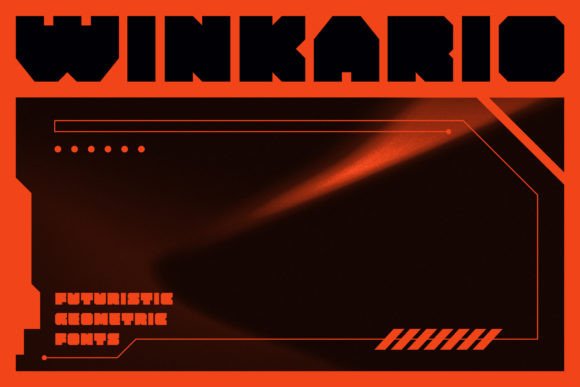
Winkario: Embracing the Geometry of Future Typography
In a digital landscape often saturated with soft gradients, rounded corners, and fluid organic shapes, there is a growing hunger for something distinct. Designers and creators are increasingly looking for visual languages that speak to structure, precision, and the raw energy of the unknown. This is where Winkario enters the conversation. Forget the curves; embrace the corners. Winkario isn't your typical font; it's a bold leap into the uncharted territory of future typography. Inspired by the stark geometry and experimental spirit of the final frontier, Winkario represents a shift away from the familiar comfort of serifs and sans-serifs toward a more architectural approach to lettering.
The Philosophy Behind the Angles
To understand Winkario, one must first understand the intent behind its creation. Traditional typefaces often prioritize legibility through familiarity, relying on curves that guide the eye gently from one character to the next. While this works well for body text in novels or standard web articles, it can feel dated when applied to visionary projects. Winkario challenges this norm by stripping away the superfluous. Every stroke is calculated, every angle deliberate. The result is a typeface that feels less like ink on paper and more like a blueprint for a new world.
This design philosophy is rooted in the concept of "functional futurism." Just as architecture has moved toward brutalist structures and sleek, angular skyscrapers, typography is following suit. Winkario captures this aesthetic by utilizing sharp vertices and rigid lines to create a sense of stability and forward momentum. It suggests that the future is not a smooth curve but a series of calculated steps, each one precise and impactful. For designers who want their work to resonate with themes of technology, space exploration, or high-concept innovation, Winkario offers a vocabulary that simply does not exist in standard font libraries.
Key Characteristics That Define the Look
What sets Winkario apart from other geometric fonts? The answer lies in its unique combination of structural integrity and expressive potential. Unlike many blocky fonts that sacrifice readability for style, Winkario maintains a surprising level of clarity while pushing the boundaries of form.
- Sharp Angularity: The defining feature of Winkario is its refusal to round out edges. Corners are crisp, creating a visual tension that grabs attention immediately.
- Variable Weight Distribution: While the lines are straight, the thickness varies dynamically, allowing for a rhythm that prevents the text from feeling static or robotic.
- Open Counterforms: The internal spaces within letters (counters) are designed to be open and breathable, ensuring that even at smaller sizes, the characters remain distinguishable.
- Modular Construction: Each character is built from a set of geometric primitives, making the font highly adaptable for logos, icons, and custom ligatures.
These characteristics make Winkario particularly effective for headlines, branding elements, and any context where a strong visual statement is required. It is not merely a font; it is a design tool that helps communicate a specific mood before a single word is read.
Practical Applications in Modern Design
While the aesthetic of Winkario is undeniably futuristic, its utility extends far beyond sci-fi movie posters. In fact, its versatility makes it a valuable asset for a wide range of industries and creative disciplines. The key to using Winkario effectively is understanding the context in which it will appear and how it interacts with other design elements.
Branding and Identity
For business owners and entrepreneurs launching startups in the tech, AI, or renewable energy sectors, Winkario offers an immediate edge. A logo created with Winkario communicates precision, reliability, and innovation. Consider a fintech company aiming to project security and modern efficiency; the sharp angles of Winkario reinforce the idea of structured data and secure transactions. Similarly, a fashion brand targeting a niche, avant-garde audience might use Winkario for its label tags and packaging to signal exclusivity and a break from traditional norms.
Digital Interfaces and User Experience
In the realm of web and app design, typography plays a crucial role in user experience (UX). While Winkario may not be suitable for long-form reading due to its distinctive shape, it excels in navigation menus, call-to-action buttons, and section headers. Its high contrast and clear structure ensure that interactive elements stand out against complex backgrounds. Designers can pair Winkario headers with a neutral, highly readable sans-serif for body text, creating a hierarchy that guides the user effortlessly through the interface.
Editorial and Print Media
Magazines, zines, and annual reports focused on culture, science, and design are finding new ways to utilize Winkario. In editorial layouts, the font serves as a powerful anchor for cover stories and feature introductions. Its ability to command space allows editors to create bold, graphic compositions that break the grid. When printed on high-quality stock, the crisp edges of Winkario render beautifully, adding a tactile quality to the publication that enhances the reader's engagement.
Evaluating Suitability: Strengths and Considerations
As with any specialized tool, Winkario is not a one-size-fits-all solution. To get the most out of this typeface, creators must evaluate their specific needs against the font's inherent strengths and limitations. Understanding these nuances ensures that the final design achieves its intended impact without compromising usability.
Strengths:
- High Impact: Winkario cuts through visual noise, making it ideal for environments where attention is scarce.
- Brand Differentiation: Its unique geometry helps brands stand out in crowded markets dominated by generic typography.
- Scalability: The modular nature of the design allows it to scale from small mobile screens to massive billboards without losing definition.
Considerations and Limitations:
Despite its advantages, Winkario requires careful handling. Because it is so visually dominant, it should generally be reserved for short bursts of text. Using it for paragraphs longer than a sentence can lead to reader fatigue, as the brain has to work slightly harder to process the unconventional shapes. Additionally, because the font relies heavily on sharp angles, it may not translate well to very low-resolution displays or materials with poor print fidelity. Creators should always test Winkario in the actual medium where it will be used to ensure the details hold up.
Another consideration is the emotional tone. Winkario conveys confidence, authority, and a certain cool detachment. It may not be the right choice for brands seeking to project warmth, empathy, or nostalgia. If your goal is to make the audience feel comfortable and safe, a softer typeface might be more appropriate. However, if you want to inspire awe, curiosity, or a sense of urgency, Winkario is an exceptional choice.
Real-World Scenarios: Bringing Winkario to Life
Imagine a conference on sustainable urban planning. The organizers want to move away from the clichéd green leaf imagery and instead focus on the structural, engineered solutions to climate change. They choose Winkario for their event signage, website, and promotional materials. The result is a cohesive visual identity that aligns perfectly with the theme of building a better, more structured future. Attendees immediately perceive the event as serious, innovative, and forward-thinking.
Or consider an independent game developer working on a cyberpunk RPG. The narrative is set in a dystopian megacity where technology rules all. The UI elements, inventory lists, and dialogue boxes are rendered in Winkario. The sharp, mechanical look of the font immerses the player in the world, reinforcing the setting without needing excessive exposition. The typography itself becomes part of the storytelling.
These scenarios illustrate that Winkario is more than just a collection of letters; it is a strategic asset. It allows creators to embed meaning into the very fabric of their communication. By choosing to embrace the corners, designers signal that they are ready to explore the uncharted territories of their respective fields.
Conclusion: A Tool for the Bold
The evolution of typography is a reflection of our changing world. As we move further into an era defined by rapid technological advancement and complex global challenges, our visual language must adapt. Winkario stands at the forefront of this shift, offering a fresh perspective that challenges the status quo. It invites us to forget the safety of curves and embrace the power of corners.
Whether you are a professional designer crafting a brand identity, a business owner looking to differentiate your product, or a creator exploring new artistic horizons, Winkario provides the tools you need to make a lasting impression. It is not for everyone, but for those willing to take a bold leap into the future, it is the missing piece for your most groundbreaking designs. By integrating Winkario into your workflow, you are not just selecting a font; you are making a statement about where you see the world going next.