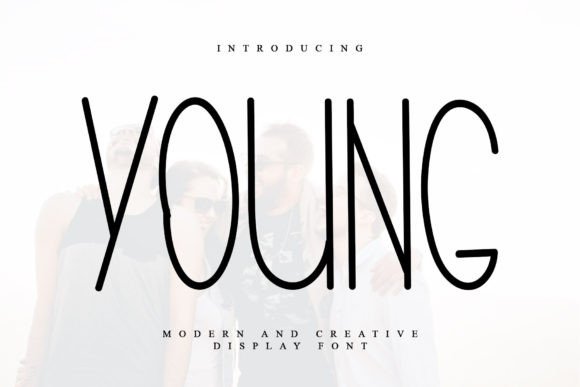
Evaluating the Young Display Font
In the realm of digital typography, the choice of a display font often serves as the defining characteristic of a brand's visual identity. Young has emerged as a notable option for designers seeking a balance between modern elegance and organic fluidity. As a display typeface, it is engineered to capture attention through its sophisticated curves and natural flow, distinguishing itself from rigid, geometric sans-serifs or traditional serif structures. For professionals researching typefaces for specific projects, understanding the functional capabilities and aesthetic limitations of Young is essential before integration.
Understanding the Design Philosophy of Young
Young is categorized primarily as a stylish display font, meaning it is optimized for use at larger sizes rather than for extended body text. Its design philosophy centers on the concept of "fluid strokes," which mimic the variability found in hand-lettering while maintaining the consistency required for digital rendering. The characters feature a natural rhythm that creates a sense of movement, avoiding the static feel common in many industrial typefaces.
The charm of this font lies in its ability to convey warmth without sacrificing sophistication. Unlike minimalist fonts that prioritize neutrality, Young injects personality into headlines and logos. The varying stroke widths and open counters contribute to a legible yet decorative appearance. This makes it particularly effective for short-form content where visual impact is prioritized over reading endurance. When evaluating this typeface, it is important to recognize that its strength is derived from its expressive nature, which sets it apart from utilitarian fonts designed solely for information delivery.
Key Reasons to Consider Young for Your Projects
Designers and marketers may find Young appealing for several strategic reasons. The primary driver is the need for a personal touch in branding. In an era where audiences crave authenticity, a font that feels human and crafted can bridge the gap between a corporation and its customers. Young achieves this by softening the edges of corporate communication, making brands appear more approachable and creative.
Furthermore, the versatility of the font allows it to adapt to various contexts within the lifestyle and creative sectors. It is frequently utilized in:
- Wedding and Event Invitations: The elegant curves provide a romantic and formal tone suitable for celebratory occasions.
- Social Media Graphics: Its distinct shape ensures high visibility in crowded feeds, helping posts stand out without relying on excessive imagery.
- Luxury Branding: The sophisticated look aligns well with high-end products, conveying quality and exclusivity.
- Personal Blogs and Portfolios: It adds a unique signature style to personal websites, distinguishing the creator's voice.
The decision to use Young often stems from a desire to elevate the perceived value of a project. By selecting a typeface with such character, designers signal an attention to detail and a commitment to aesthetic excellence.
Benefits and Tradeoffs: A Balanced View
While Young offers significant aesthetic advantages, it is not without tradeoffs. The most prominent benefit is its immediate emotional resonance. The fluidity of the strokes creates a captivating look that engages viewers quickly. This is particularly valuable in advertising and promotional materials where the goal is to stop the scroll and capture interest.
However, the very features that make it attractive also limit its scope. Because Young is a display font, it suffers from reduced legibility when used at small point sizes or in dense paragraphs. The intricate details of the fluid strokes can blur or become indistinguishable on low-resolution screens or when printed in fine print. Consequently, it is ill-suited for long-form reading materials such as articles, reports, or book interiors.
Another consideration is the potential for visual fatigue. Fonts with high contrast and strong personality can dominate a layout if overused. If applied to every headline and subheading within a single document, the design may feel chaotic rather than cohesive. Effective usage requires restraint, reserving Young for focal points where its impact is most needed.
Ideal Use Cases and Scenarios
To determine if Young aligns with your goals, consider the specific context of your project. It is a strong fit for situations requiring brevity and high visual impact. For instance, a logo for a boutique bakery or a fashion line benefits immensely from the font's warm and creative vibe. Similarly, social media stories or Instagram headers utilize the font's natural flow to create dynamic compositions that feel spontaneous and authentic.
It also excels in print media where resolution is controlled, such as business cards, packaging labels, and event programs. In these scenarios, the nuances of the fluid strokes are preserved, allowing the font to exude the elegance intended by its designer. When the project involves a limited amount of text—such as a tagline or a call-to-action button—Young provides the necessary distinction to guide the user's eye effectively.
When to Consider Alternatives
Despite its strengths, there are clear scenarios where alternatives to Young should be considered. If the primary objective is readability across diverse devices and screen sizes, a robust sans-serif or a classic serif font is a safer choice. For example, mobile app interfaces or news websites require typefaces that remain crisp and legible at 10pt or smaller; using Young in these contexts would likely hinder the user experience.
Additionally, projects demanding a neutral or strictly professional tone may find Young too expressive. Industries such as finance, legal services, or heavy manufacturing often rely on typography that conveys stability and objectivity. The whimsical and charming nature of this font could undermine the seriousness required in these fields. In such cases, a more geometric or traditional typeface would better serve the brand's authority.
Finally, if the design system requires extensive weight variations (light, regular, bold, black) for hierarchical structuring, one must verify the availability of these styles in the Young family. Display fonts often come in limited weights, which can restrict flexibility in complex layouts. If a project demands a full spectrum of typographic hierarchy, a comprehensive font family might be a more practical investment.
Practical Decision-Making Insights
Selecting the right typeface is a strategic decision that impacts how a message is received. When evaluating Young, ask yourself whether the project prioritizes emotional connection or informational clarity. If the goal is to evoke feelings of warmth, creativity, and sophistication in a short format, this font is a compelling candidate. However, if the priority is efficient communication of large volumes of data, the tradeoffs in legibility make it a poor fit.
Before committing to Young, conduct a mock-up test. Place the font in your actual design environment alongside other elements like images and secondary text. Observe how it performs on different backgrounds and at various scales. Does it maintain its charm when paired with a simple sans-serif body text? Or does it clash with the overall composition? These practical tests will reveal whether the font enhances the design or distracts from the core message.
Ultimately, the value of Young lies in its ability to add a distinctive, human element to digital and print designs. By understanding its specific strengths and limitations, designers can leverage its elegance and charm effectively, ensuring that the final output resonates with the intended audience while maintaining functional integrity.