Great Bucket: A Practical Evaluation of a Playful Display Typeface
In the landscape of digital and print design, selecting the right typeface is often a balance between aesthetic appeal and functional legibility. Great Bucket has emerged as a distinctive option for designers seeking to inject energy and warmth into their projects without sacrificing clarity. As a display font, it is not intended for long-form body text but rather serves as a powerful tool for headlines, logos, and short statements where immediate visual impact is required. Understanding its specific characteristics, strengths, and limitations is essential for determining whether it aligns with your project goals or if an alternative approach might serve you better.
Defining the Character of Great Bucket
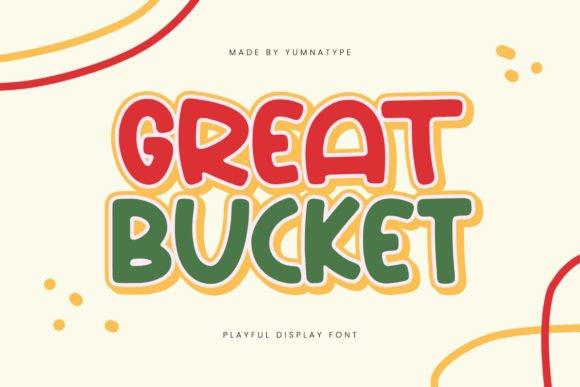
At its core, Great Bucket is defined by its whimsical letterforms and robust construction. The font distinguishes itself through a thick weight that commands attention while maintaining a soft, approachable demeanor. Unlike many bold typefaces that rely on sharp serifs or aggressive angles to create presence, Great Bucket utilizes rounded shapes to achieve a harmonious look. These smooth curves soften the overall appearance, making the text feel friendly and inviting rather than imposing.
The low contrast between the strokes is another defining feature. In typography, contrast refers to the difference in thickness between the thinnest and thickest parts of a letter. Great Bucket minimizes this variance, creating a uniformity that enhances readability even at smaller sizes or from a distance. This consistency ensures that the playful essence of the font does not come at the cost of legibility. The result is a typeface that feels substantial and grounded, yet retains a lighthearted spirit suitable for brands targeting families, children, or creative industries.
Comparing Great Bucket to Standard Display Fonts
When evaluating Great Bucket against other options in the display category, several key differences become apparent. Many display fonts prioritize extreme stylization over usability, often featuring intricate details that can blur when scaled down or viewed on lower-resolution screens. Great Bucket takes a more pragmatic approach. Its thick weight and rounded geometry ensure that the character remains distinct across various media, from large billboards to mobile app icons.
Compared to traditional slab serifs, which also offer a heavy, blocky appearance, Great Bucket lacks the rigid structure and sharp corners typical of that category. While slab serifs convey stability and authority, they can sometimes feel industrial or cold. Great Bucket introduces a layer of organic softness that makes it more versatile for lifestyle, education, and entertainment sectors. Conversely, when compared to thin, script-like display fonts, Great Bucket offers significantly higher legibility. Script fonts often struggle with clarity in all-caps or tight kerning, whereas the uniform stroke width of Great Bucket allows for tighter spacing without losing the individual identity of each letter.
Visual Weight and Readability Tradeoffs
The thick weight of Great Bucket is both its greatest asset and a potential constraint depending on the context. For headlines and titles, this weight provides a strong visual anchor, ensuring the message is captured instantly. However, this same characteristic means the font consumes more white space than lighter alternatives. Designers must consider how much room the text will occupy within a layout. If a design requires a lot of information in a small area, Great Bucket may feel too dominant, potentially overwhelming supporting elements.
Furthermore, the rounded nature of the font affects how it pairs with other typefaces. Because Great Bucket is so visually distinct, it often works best when paired with a neutral, sans-serif font for body copy. Using it alongside another highly stylized or decorative font can create visual competition, leading to a cluttered and confusing user experience. The goal is to let Great Bucket shine as the focal point while allowing secondary text to recede into the background.
Ideal Use Cases and Application Scenarios
Great Bucket excels in environments where playfulness and approachability are central to the brand identity. It is particularly well-suited for:
- Children's Products and Services: The soft curves and friendly vibe make it an excellent choice for educational materials, toy packaging, and apps designed for young audiences.
- Creative Workshops and Events: Posters, flyers, and social media graphics for art classes, craft fairs, or community gatherings benefit from the font's energetic character.
- Lifestyle Branding: Brands in the food, beverage, or casual apparel sectors can use Great Bucket to convey a sense of fun and relaxation.
- Short-Form Headlines: Blog titles, YouTube thumbnails, and banner ads where quick recognition is crucial.
In these scenarios, the font's ability to communicate tone instantly is invaluable. It bridges the gap between professional design and informal communication, making complex or serious topics feel more accessible. For instance, a health clinic specializing in pediatric care might use Great Bucket for its logo to reassure parents and children alike, signaling a gentle and caring environment.
Limitations and Decision Factors
While Great Bucket offers significant advantages, it is not a universal solution. There are specific situations where its characteristics may be detrimental to the design objectives. One primary limitation is its unsuitability for extended reading. The thick strokes and playful shapes can cause eye fatigue if used for paragraphs of text. Readers expect body copy to be unobtrusive and easy to scan; Great Bucket draws too much attention to itself for this purpose.
Additionally, the font's whimsical style may clash with brands that need to project seriousness, luxury, or high-tech sophistication. A law firm, a financial institution, or a luxury automotive brand would likely find the rounded, bubbly aesthetic of Great Bucket inappropriate. In such cases, a serif font with higher contrast or a geometric sans-serif would better align with the desired perception of authority and precision.
Another consideration is the versatility of the font family. If a project requires multiple weights (light, regular, bold, italic) to establish a clear hierarchy, Great Bucket may fall short if it is only available in a single, heavy weight. Designers relying solely on this font might struggle to differentiate between a main headline and a subheadline without resorting to drastic changes in size or color, which can disrupt the visual flow.
Evaluating Alternatives and Complementary Tools
When deciding whether to proceed with Great Bucket, it is helpful to consider what alternatives exist if the font does not meet every requirement. If a designer needs a playful font but requires better legibility for longer text blocks, a rounded sans-serif with a medium weight might be a better fit. These fonts retain the softness of Great Bucket but offer a wider range of weights and better readability for body copy.
Alternatively, if the goal is to maintain a bold presence but with a more modern or edgy feel, a geometric blackletter or a condensed display font could provide the necessary impact without the "whimsical" association. The decision ultimately depends on the specific emotional response the design aims to evoke. Great Bucket is a specialized tool designed for a specific niche: creating a warm, engaging, and fun atmosphere in short bursts of text.
Strategic Pairing for Maximum Impact
To maximize the effectiveness of Great Bucket, strategic pairing is essential. Since the font is so expressive, it should be treated as the star of the show. Pairing it with a clean, minimalist sans-serif like Helvetica, Roboto, or Open Sans can create a balanced composition. The neutrality of the body text allows the Great Bucket headlines to stand out without competing for attention. This combination leverages the strengths of both typefaces: the personality of the display font and the functionality of the workhorse body font.
Color selection also plays a role in how Great Bucket is perceived. While the font looks great in solid, vibrant colors, using it in gradients or textured fills can enhance its three-dimensional quality. However, designers should avoid overly busy backgrounds that might obscure the rounded edges of the letters. Ensuring sufficient contrast between the text and the background is critical to maintaining the font's inherent legibility.
Making the Final Decision
Choosing Great Bucket is a decision about tone and intent. It is a font that speaks loudly and cheerfully, making it an excellent choice for projects that need to connect emotionally with an audience quickly. Its thick weight, rounded forms, and low contrast create a unique visual signature that is both memorable and readable. However, its limitations regarding long-form text and formal contexts mean it should be used selectively.
Before committing to Great Bucket, designers should ask themselves if the project truly benefits from a playful, whimsical aesthetic. If the answer is yes, and the text volume is limited to headlines or short phrases, Great Bucket is a strong contender. If the project demands versatility across different weights or a more serious tone, exploring other categories of display or body fonts may yield better results. By understanding these nuances, designers can ensure that their typographic choices support the overall message and enhance the user experience effectively.